Balance Sheet
This guide explains the Balance Sheet report of MyCloudBook: how to open it, how to read the assets, the liabilities, and the equity of the company on a date, how to compare several dates, and how to print the report or download it as an Excel file.
Overview
The Balance Sheet shows the financial position of the company on a date: what the company owns (the assets), what it owes (the liabilities), and what belongs to the owners (the equity). The total of the assets always equals the total of the liabilities and the equity.
MyCloudBook builds the Balance Sheet from the journal posts of every posted document up to the date of the report. The report can show one date, or the end of every year, quarter, or month of a period side by side.
How to open the report
- In the left navigation, click Reports. The Reports tab lists the reports in four groups.
- In the group Standard Accounting Reports, double click Balance Sheet.
- The report opens in its own tab and is created at once with the default settings. When the tab is open already, it becomes the active tab and keeps its settings.
A report tab can be closed with its x. The next double click opens the report again with the default settings.
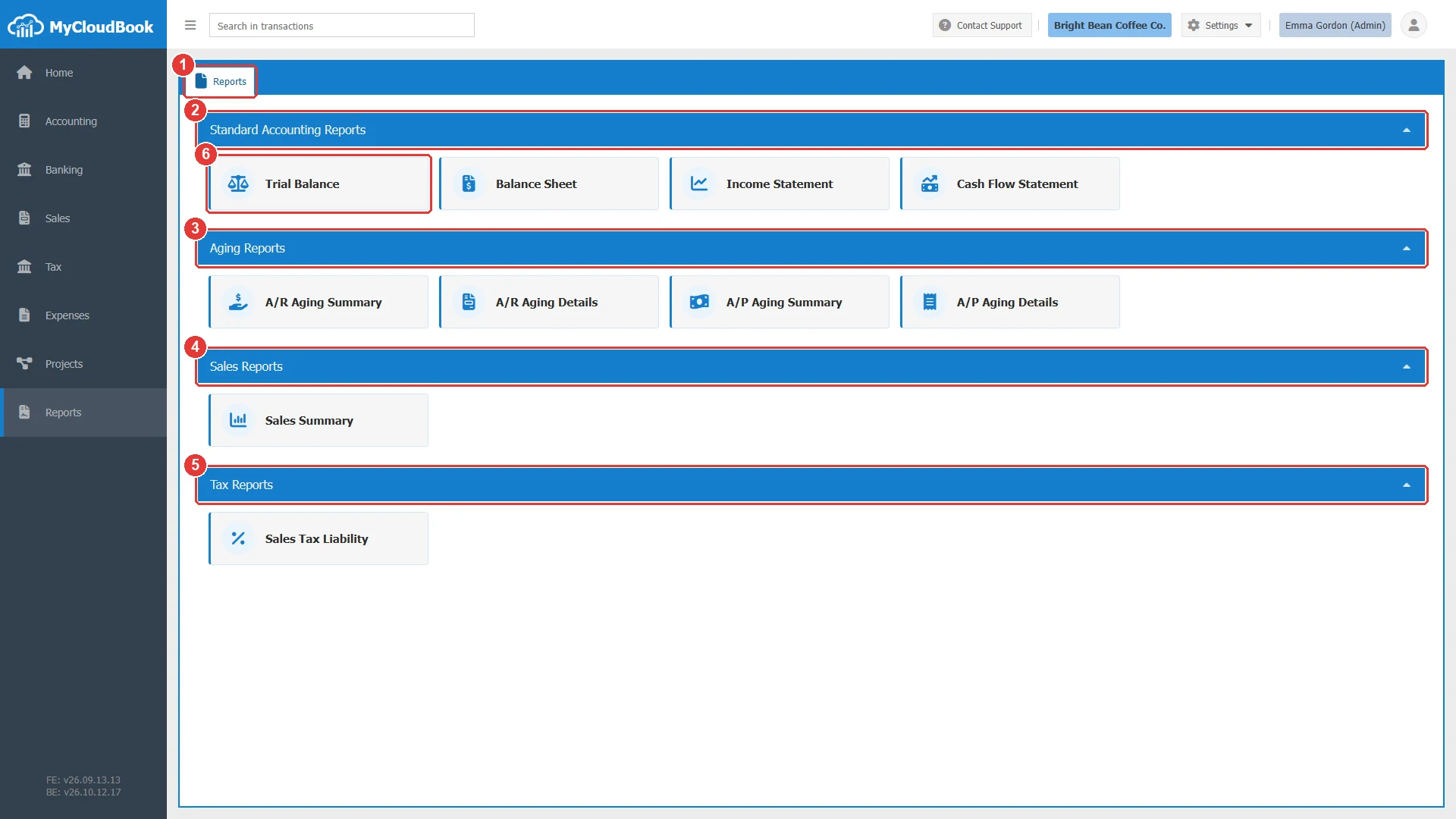
- 1The Reports tab. It is always the first tab of the Reports page.
- 2Standard Accounting Reports: Trial Balance, Balance Sheet, Income Statement, and Cash Flow Statement. A click on the title of a group hides or shows its reports.
- 3Aging Reports: A/R Aging Summary, A/R Aging Details, A/P Aging Summary, and A/P Aging Details.
- 4Sales Reports: Sales Summary.
- 5Tax Reports: Sales Tax Liability.
- 6A report, here Trial Balance. A double click opens it.
The report screen
The report screen has two parts. The center shows the report as a Portable Document Format (PDF) document in the PDF viewer of the browser. The Report Setting panel at the right holds the settings of the report. After a change of the settings, click Reload to create the report again. The arrow in the header of the panel hides the panel, so the report gets more room.
The example shows the company Bright Bean Coffee Co. on Sep 30, 2026, the end of the third quarter.
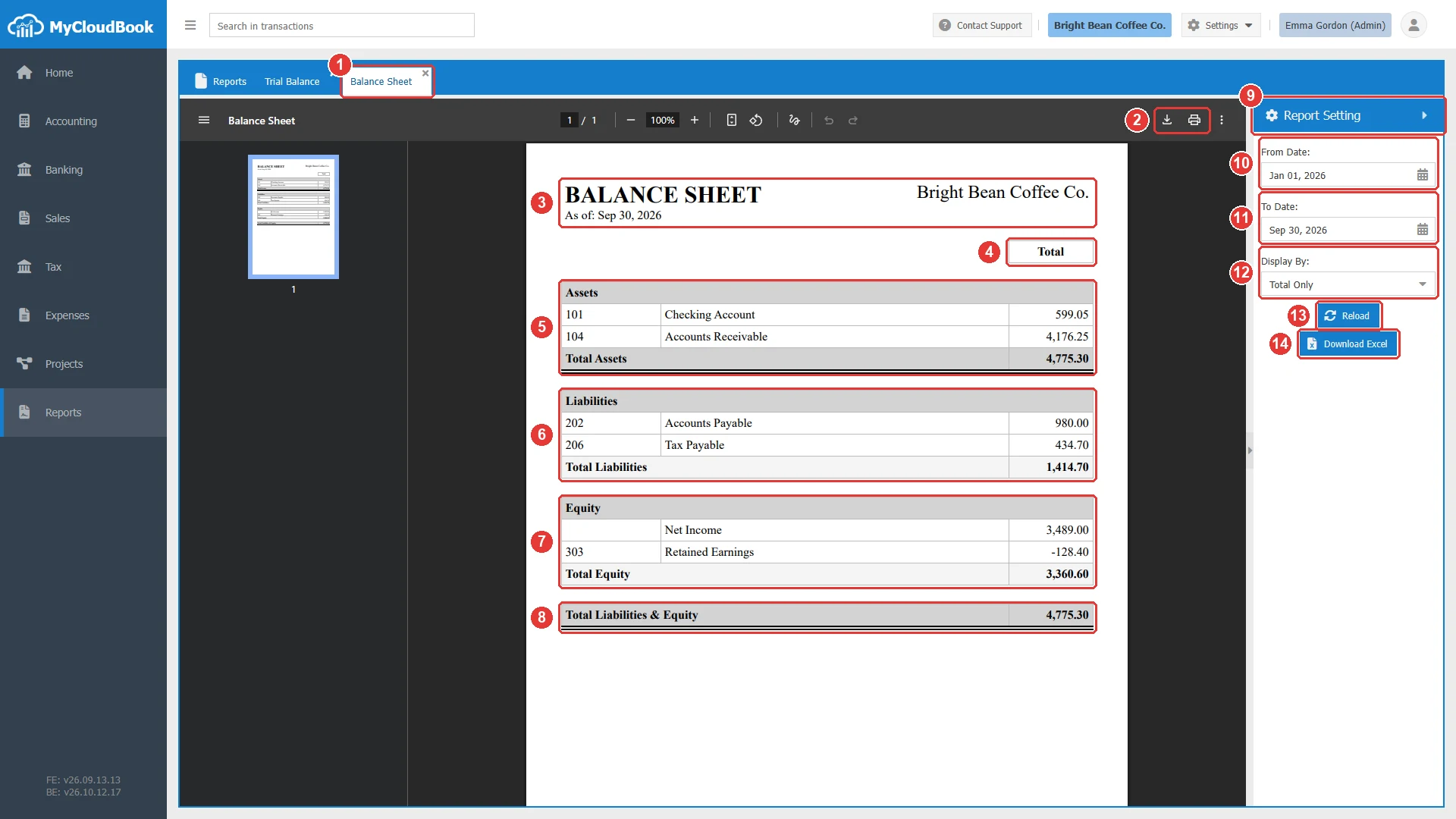
- 1The Balance Sheet tab. The x closes it.
- 2The download and print buttons of the PDF viewer of the browser.
- 3The title of the report, BALANCE SHEET, the date As of, and the name of the company.
- 4The column of the amounts. With Display By Total Only it is named Total.
- 5Assets. The asset accounts with their balances, and Total Assets.
- 6Liabilities. The liability accounts with their balances, and Total Liabilities.
- 7Equity. The line Net Income, the equity accounts, and Total Equity.
- 8Total Liabilities & Equity. It equals Total Assets.
- 9Report Setting. The panel with the settings of the report.
- 10From Date. The start of the period for the columns of Display By Years, Quarters, or Months.
- 11To Date. The date of the balances. It starts with today.
- 12Display By. Total Only, Years, Quarters, or Months.
- 13Reload. Creates the report again with the settings of the panel.
- 14Download Excel. Downloads the report as the Excel file Balance Sheet.xlsx.
The settings
| Field | Required | Purpose and rules |
|---|---|---|
| From Date | Required | The first day of the period of the columns. It starts with January 1 of the current year. It must not be after the To Date. |
| To Date | Required | The date of the balances, and the end of the last column. It starts with today. |
| Display By | Required | Total Only (the default) shows one column with the balances on the To Date. Years, Quarters, and Months show one column for each period from the From Date to the To Date. |
How to read the report
| Line | How MyCloudBook computes it |
|---|---|
| Account rows | The balance of the account on the date: all its posts up to the date. Asset accounts show the debits minus the credits. Liability and equity accounts show the credits minus the debits. A negative amount is a balance on the other side of the account. |
| Net Income | The income minus the expenses of all posts up to the date. It is the profit that the company earned and that is not yet in an equity account. |
| Total Equity | The equity accounts plus the Net Income line. |
| Total Liabilities & Equity | Total Liabilities plus Total Equity. It equals Total Assets. |
| Rows that are not listed | An account with a zero balance in every column. A main account, because its sub accounts carry the amounts. The income and expense accounts, because the Net Income line holds their result. |
In the example, the company has 599.05 in the checking account and 4,176.25 to receive from customers, so Total Assets is 4,775.30. It owes 980.00 to suppliers and 434.70 of sales tax, and the Net Income of the year is 3,489.00. Liabilities and equity together are also 4,775.30.
Several dates side by side
Display By compares several dates in one report. Each column shows the balances at the end of its period. A period that starts or ends inside a month is named with its two dates.
- Years: one column for each calendar year, for example Jan - Dec, 2026.
- Quarters: one column for each calendar quarter, for example Jul - Sep, 2026.
- Months: one column for each calendar month, for example Sep 2026.
The example sets the From Date to Aug 01, 2026 and Display By to Months. The report shows the balances on August 31 and on September 30 side by side.
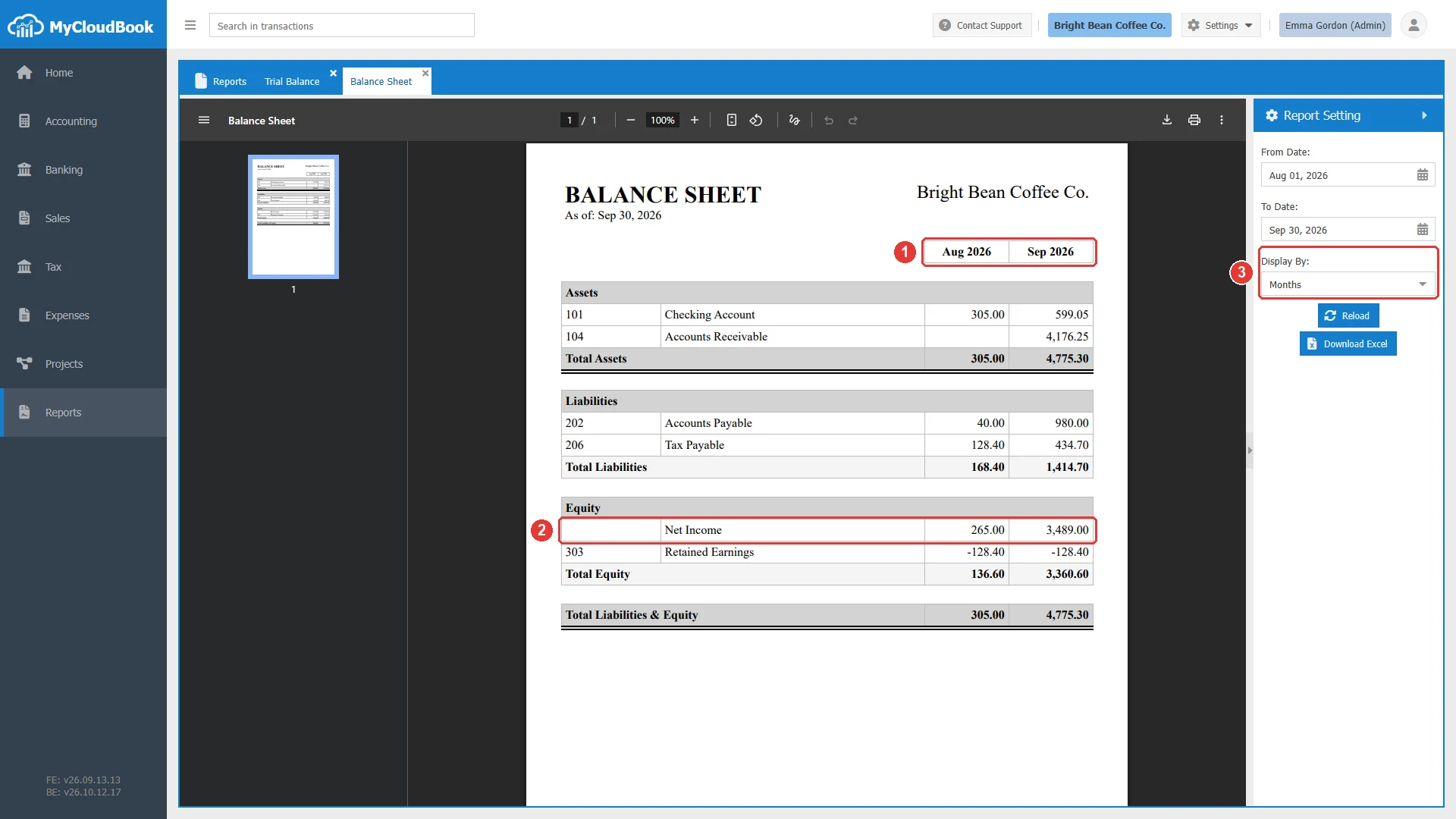
- 1One column for each month. Each column shows the balances at the end of the month.
- 2Net Income. The result up to the end of each month: 265.00 at the end of August, 3,489.00 at the end of September.
- 3Display By. Months.
Printing and Excel
- To print the report, click the print button of the PDF viewer. To keep it as a PDF file, click the download button of the PDF viewer.
- To work with the figures in a spreadsheet, click Download Excel. MyCloudBook creates the report with the settings of the panel and downloads it as Balance Sheet.xlsx. The Excel file has the same rows, a header that stays visible, and a print setup with page numbers.
- The report shows the posted data at the moment of the Reload. After new documents are saved, click Reload again.
Messages and their meaning
Questions and answers
What is the Net Income line of the Balance Sheet?
The income minus the expenses of all posts up to the date of the column. It is the profit of the company that is not yet moved into an equity account.
Why do Total Assets and Total Liabilities & Equity always match?
Every journal entry has equal debits and credits. The assets are therefore always equal to the liabilities plus the equity, which includes the Net Income line.
How do I compare the balances of several months?
Set the From Date to the first month, set Display By to Months, and click Reload. Each column shows the balances at the end of a month.
Why is an account missing from the Balance Sheet?
Its balance is zero in every column, or it is a main account. Income and expense accounts are summarized in the Net Income line.
Where do I see the income and the expenses of a period?
In the Income Statement. It lists the income and expense accounts of the period and the net income of the period.